
Chickweed (Stellaria media)
General Info and Identification
Initially native to Europe, Chickweed has spread to many continents including the North American East Coast. It can grow naturally in urban areas or in a multitude of rural environments. Identified by its hairy stems, oval leaves and white flowers, Chickweed can grow from between 6 inches to 2 feet. Chickweed’s rich vitamin C, magnesium and calcium content along with its grassy/earthy flavor has made it a staple ingredient in many medicinal and cooking recipes.
Harvesting
Chickweed grows into the late fall, often ready for harvest early winter. Signs that the plant is ready for harvest include its large size, budding, and a display of lush green coloration. Aside from the roots, the entire plant is safe for consumption. Typically, it is recommended to prune 2-3 inches off the top of the plant to allow for renewal during the next harvesting cycle. The leaves can be taken as well.
Safety
While Chickweed is safe, it is not recommended to take in high doses or while pregnant as doing so may cause diarrhea and vomiting. Additionally, at certain stages of its development Chickweed can resemble a poisonous plant known as Spotted Spurge (Euphorbia maculata). A good rule of thumb to go by is that if the stem oozes a milky white sap, it is NOT chickweed.
Uses
Chickweed has been used for many years in various medicinal remedies due to its anti-inflammatory, digestion boosting, respiration boosting, and healing properties. While Chickweed can be eaten raw or cooked like any other herb in recipes, typically it is consumed in the form of a tea or within a salad.
Recipe
Ingedients:
- Chickweed leaves
- Water
- (Optional) honey
- (Optional) Lemon juice
Chickweed Tea
- Wash the herb, especially if freshly foraged to remove any dirt.
- Finely chop the chickweed leaves for better infusion.
- Place the cut leaves in a cup and pour boiling water over it.
- Cover the cup for 10 minutes allowing for it to steep
- Strain the tea, removing the leaves
- The tea is now ready, but you can always add lemon or honey if desired.

Field Garlic (Allium vineale)
General Info and Identification
Field garlic is widespread across many European countries and is commonly found along the East Coast of the United States. Due to its status as an invasive species in the United States it easily spreads and grows in many environments. It is also a good source of vitamins C and A along with iron and sulfur. Field Garlic can be mistaken for other plants such as grass or wild onions as they may look incredibly similar. It can be identified by its tubular and hollow leaves along with the papery skin over its bulbs and garlic smell.
Harvesting
Field garlic is a resilient plant, growing throughout the winter months and is typically harvested during the spring or early summer. Signs that it is ready for harvest are if the plant's leaves are bright green, the bulbs are visible, and if you can smell the scent of garlic. When harvesting, if you are after chives, the thinnest leaves are ideal to cut off. If you are after the garlic bulbs, then the more clumped and larger the leaves the better.
Safety
No safety concerns
Uses
Field garlic can be used in any recipe as a substitute for domestic garlic, the only major difference between the two being the much smaller size of Field Garlic. The plant possesses respiratory and digestive boosting properties along with antibacterial and antifungal properties. These attributes, along with its flavorful taste, allow for the plant's inclusion in a myriad of medicinal and cooking recipes.
Recipe
Ingedients:
- 2 cups all-purpose flour
- ½ tsp. sal
- 1 cup finely chopped field garlic
- Vegetable oil, as needed for cooking
Field Garlic Pancakes
- Mix the flour and salt together by thoroughly stirring them.
- Pour and stir ¾ cup of boiling water into the flour mixture. If the dough seems dry, gradually add at most ¼ cup more water.
- Once the dough has formed knead it gently until it’s smooth.
- Put the dough back into the bowl, covering it to rest for at least 10 minutes.
- Wash and dry the field garlic before chopping it into small pieces.
- Once the dough has rested, divide it into 8 rectangular equal parts.
- Brush each rectangle with vegetable oil and sprinkle about 2 tablespoons of the chopped field garlic evenly onto each part. Then roll up and coil the dough into a spiral.
- Flatten each spiral with a rolling pin into a thin pancake about 7 inches across.
- Heat a skillet with a small amount of vegetable oil over medium heat. Place the pancake inside and cook for about a minute on each side until done.
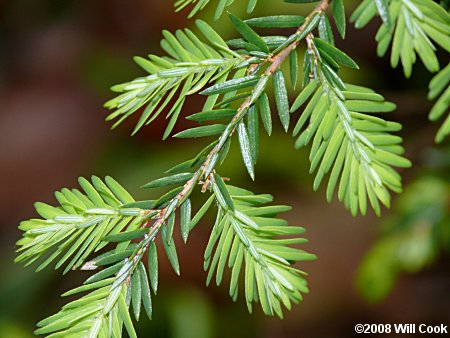
Eastern Hemlock (Tsuga canadensis)
General Info and Identification
Eastern hemlock is native to the Eastern United states and Canada. The tree prefers cool and wet areas often found around water and in forests. It is a type of pine and its needles can be identified by their feather-like angled formation. The needles are small averaging around half an inch long and each individually attached to its branch by a small stem.
Harvesting
Eastern Hemlock is best gathered when the needles are a vibrant green. The harvesting process is extremely straightforward as often the needles fall off the tree and can just be picked up. Alternatively, you can cut them off of the trees without causing any harm.
Safety
There are many types of pine needles, some safe for consumption and others not. It is best to avoid Lodgepole Pine, Monterey Pine, Ponderosa Pine, Norfolk Pine (Australian Pine), Loblolly Pine, Common Juniper, and, while it is not a pine but can be mistaken for one, Yew needles. If you are not certain the pine needles are safe, DO NOT CONSUME. A good rule to go by is that if it is flat, avoid it.
Uses
Eastern Hemlock can be used in many different ways. Typically, the needle itself is not eaten but rather used in teas, syrups, seasonings, or even alcoholic drinks. They also have various other applications such as as a compost material due to their abundance, or are used in weaving.
Recipe
Ingedients:
- Fresh Eastern Hemlock and twigs
- Brandy
- Raw honey
Eastern Hemlock Cordial
- Chop up the Eastern Hemlock needles and thin twigs.
- Place the chopped hemlock into a glass jar and cover it with a mix of about 75% brandy and 25% raw honey.
- Once the dough has formed knead it gently until it’s smooth.
- Seal the jar and let it sit for a month. The longer it sits, the more infused the ingredients will be, amplifying their flavor.
- After the infusion, strain out the plant material. What's left can be directly enjoyed, used as a medicinal tonic, or mixed with other drinks.